Japanese Guy Who Is Blind but Can Fight Martial Arts 1950
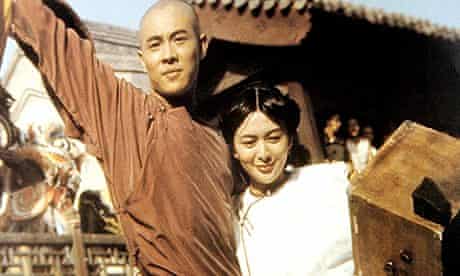
x. Once Upon a Time in Cathay
The film that kick-started Hong Kong cinema's kung-fu renaissance and launched Jet Li towards a future of substandard western activeness movies. Its subject was already well known to local audiences: Wong Fei-hung was a existent person: a turn-of-the-century martial arts master and healer who's go something of a folk hero. Like Sherlock Holmes or Robin Hood, he'd been portrayed many times before. Jackie Chan played him in Drunken Master, and a long-running Wong Fei-hung film series during the 1950s and 60s gave roles to the fathers of Bruce Lee and Yuen Wo-ping, amidst many others.
Transposed to 1990s Hong Kong, with the handover from British to Chinese sovereignty on the horizon, this story of a Chinese insubordinate fighting oppressive colonialist powers had extra resonance. Its British and American baddies are cartoonishly demonised, and the plot is oft convoluted to the point of impenetrability, admittedly, but what this film chiefly provides is dazzling, colourful, kinetic, epic, pre-CGI spectacle. Director Tsui Hark, schooled in both the US and Hong Kong, fills the screen with move and energy. The wire-assisted fight scenes – choreographed by Yuen Wo-ping, inevitably – are ingeniously staged. Earthbound reality is left far behind.
And Li is simply incredible. He'due south got gravitas every bit an actor, but when he's in action, he really takes some beating. He does information technology all: fighting with hands, feet, sticks, poles, umbrellas. He kills one baddie with a bullet – without using a gun. But Li is a gymnast, as well, pirouetting and somersaulting across the screen with the agility of a cat. He's surely the most svelte martial artist out there. Those skills come to bear in a jubilantly able-bodied final duel, which takes place in a warehouse conveniently full of bamboo ladders. Information technology's one of the nearly celebrated sequences in martial arts movies, and information technology leaves you lot wanting more, of which there is plenty: they fabricated iv sequels in the next two years. Steve Rose
ix. Yojimbo
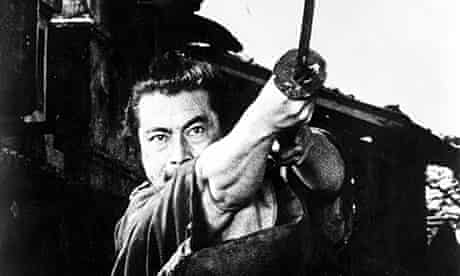
Akira Kurosawa drew upon American lurid sources for Yojimbo's plot, principally the Hollywood western but also Dashiell Hammett's broken-city melodrama The Dain Curse. Here a lone, probably disgraced, certainly hungry samurai (Toshiro Mifune, the Wolf to Kurosawa's Emperor) wanders into a town where two factions are in eternal conflict, glaring at one another from their matching headquarters on opposite sides of the town'southward wide, western-similar chief street. Since each faction lacks a distinguished warrior with whose aid they might tip the balance of power in their favour, they each badly want the newcomer on their side, something the samurai figures out within moments, and exploits throughout the movie.
Equally the power games play out to their nihilistic, corpse-high-strung decision, Kurosawa demonstrates a mastery of his medium in almost every frame. His sense of spatial relations is beyond compare: panels in interior walls slide away to reveal whole exterior street-scapes and oversupply scenes perfectly framed inside the smaller new frame. Intimate conversations take place as a turbulent skirmish rages in the deep background heart-screen, betwixt the talkers' faces in the foreground. And what faces! From the moronic warrior with the Thousand-shaped unibrow and the giant wielding a huge mallet to Mifune's increasingly dilapidated countenance, sardonic, cynical and e'er defiant, every single face up is at one time a landscape and an ballsy verse form unto itself.
Along with all that comes Kurosawa'due south furious visual energy, his virtuoso choreography of moving camera and bodies of warring men; and his talent for adding enriching layers of kinetic, elemental motion – pelting falling, leaves or smoke blowing in the unceasing winds – to the violence already in play. Yojimbo led to the Italian A Fistful of Dollars, which in time completely remade the American western, completing a circumvolve of international cultural commutation that foreshadows a give-and-take amid international filmmakers that we take for granted today. John Patterson
8. A Touch of Zen
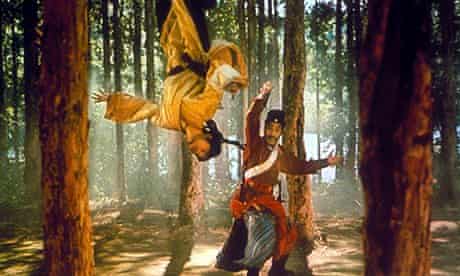
We have A Touch on of Zen to give thanks for Harvey Weinstein's involvement in Asian cinema; it was after Quentin Tarantino screened Rex Hu'south 1971 wuxia that the mogul began a controversial spending spree in the east that led to his current controversial involvement with Bell Joon-ho's Snowpiercer. It's not hard to come across why: Hu's pic is unusually epic for the genre, clocking in at over three hours, and made cinema history by being the beginning Chinese movie to win an award at Cannes, missing out on the Palme d'Or but taking abode the Technical prize.
A Touch of Zen is about notable nowadays as the template for Ang Lee's Crouching Tiger, Subconscious Dragon, being the 14th century story of an artist, Ku, who encounters a beautiful woman living in a rundown house with her elderly mother. In true wuxia way, however, she is not all she seems, then the story grows, until Ku realises that he is in the middle of a major dynastic state of war between rival factions. And as the story develops – effortlessly arresting elements of comedy and romance – then does the spectacle, increasing in scale and scope in ways that would be unimaginable today.
It is these fight sequences that have endured, and although wuxia briefly brutal out of favour shortly afterward, it is easy to see Hu's influence on the hit martial arts films of recent years. More so than Crouching Tiger, A Touch of Zen casts a long shadow over the films of Chinese director Zhang Yimou, whose House Of Flying Daggers directly references Hu's film in its bravura bamboo forest sequence. But it is Hu'southward deadpan sense of the grand that keeps this astonishing film fresh, with its themes of justice and nobility, shot through with a strange spirituality that earns the film its title in a sequence involving a pack of bouncing, kick-donkey Buddhist monks. Damon Wise
7. The Raid
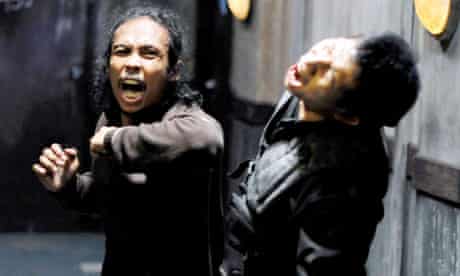
As a breathless and barbarous martial arts thriller shot in Djakarta and directed by a Welshman, The Raid would already have been worthy of note. That it is a film of precision and inventiveness, taking fight sequences into the realm of horror, slapstick comedy, even the musical, guarantees its place in activeness-movie history. The plot is as uncomplicated as its choreography is complicated. A police unit of measurement sets out one morning to seize control of a belfry block in Jakarta that has fallen into the hands of a gang. Just not but any gang: this mob has kitted out the loftier ascent with sophisticated CCTV and public address systems monitored from a pinnacle-floor control room. The gang-lord, presiding over the CCTV screens, broadcasts a telephone call to his tenants: "We take company. You know what to practise." He doesn't hateful put the kettle on and crack open up the custard creams.
In the absence of much dialogue, the weapons practice the talking: guns, knives, swords, hammers. A human being receives an axe to the shoulder, which is then used to yank him across the room. A refrigerator doubles as a flop. The gang'due south most barbarous member, Mad Domestic dog (Yayan Ruhian, who also served equally one of the film'south fight choreographers), acts as mouthpiece for the pic'southward philosophy. Casting bated his firearms, he explains: "Using a gun is like ordering takeout." If that's the example, Mad Dog would merit a fistful of Michelin stars.
Some of the fight sequences are enclosed claustrophobically in hallways where the simply choice is to use walls as springboards, Donald O'Connor-style. Others, such equally a dust-up in a drugs lab, aggrandize similar trip the light fantastic numbers. Evans's prime accomplishment has been to make a berserk risk characterised by clarity. In contrast to most action picture palace, the frenzy arises from the performers rather than the editing; no matter how frenzied things become, we never lose sight of who is karate-chopping the windpipe of whom. Ryan Gilbey
6. Ong-Bak
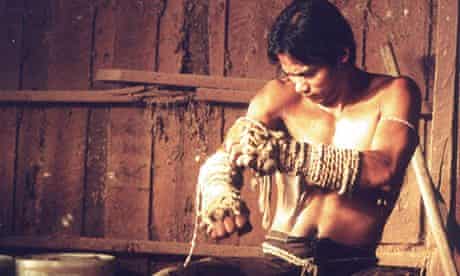
Hands and feet are one thing in martial arts; elbows and knees are quite another. And after seeing this Muay Thai showreel, you'd put coin on Tony Jaa against whatsoever other screen fighter. Even in the scenes where Jaa isn't fighting anyone at all, simply going through some moves, he's awesomely formidable.
Ong Bak every bit a film is fairly straightforward: city baddies steal a village'south Buddha head; a humble peasant goes to get it back, individually crushing each adversary with his bare easily in the process. That'due south all it needs. Ong Bak's prime objective is to say, "Tin y'all believe this guy?" and with the added note that no special effects or stunt doubles were used, it more than accomplishes information technology. In fight after fight, Jaa unleashes moves that leave you thinking, "That'south gotta injure", if non "That's gonna require major cranial reconstruction". No holds are barred and few punches are pulled, just rather than brute violence, you're left marvelling at Jaa's speed, technique and pain threshold. The fights are skilfully staged, peculiarly an exhilarating, iii-circular barroom brawl that leaves no opponent or piece of furniture standing.
Jaa shows off his physical prowess in other ways, too, from an opening tree-climbing race to a Bangkok street chase that sends him along a hilarious attack course of cafe tables, market stalls, children, cars, trucks, sheets of glass and hoops of barbed wire. He's near too much to believe, and Ong Bak acknowledges our incredulity by frequently rewinding the activity to show u.s. Jaa's moves in tedious move, as if to say, "Do you want to see that again?". We do. SR
5. The Matrix
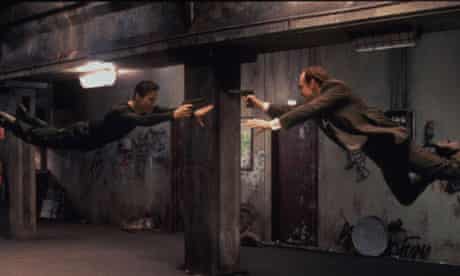
Cocteau imagined the mirror as a gateway to another world in his 1930 film The Blood of a Poet, and information technology'southward a testament to the durability of this image that when it turned up over again in The Matrix, information technology had lost none of its allure. The motion-picture show clocks up a farther debt in its plot, which proposes that what we perceive every bit reality is actually a cosmetic facade constructed to conceal a terrible truth about our existence. Neo, a computer boffin played by Keanu Reeves, is selected to bear the burden of enlightenment. Reeves'southward blankness in the part is perfect, mainly because Neo is required to display only those skills and qualities that are downloaded into his brain. Required to master jujitsu, he is simply installed with the relevant reckoner plan. In no time at all, he is pulling off those tricks from 1970s martial arts movies, where a man can launch himself in a flying kicking and somehow manage to set up a cocktail, read a brusk novel and fill out his revenue enhancement return, all before his feet touch the ground.
The film'due south Cocteau-esque concept is harnessed to some Ten-Files-style paranoia, but it is the dazzling martial arts work that gives the film its special lift. The directors, the Wachowski brothers, were already having ideas to a higher place their station when they came upwardly with The Matrix (their only previous moving picture, later on all, was the sweaty, claustrophobic thriller Bound). It was the martial arts choreographer Yuen Woo-ping who helped them attain the next level.
The motion-picture show's fight sequences provide its purest source of pleasure for a number of reasons. Showtime, the violence doesn't come with redemptive overtones; it is played out for the thrill of the choreography, non the apprehension of injury or righteousness. Death is flippant, but it provides no moral kick. 2nd, the film introduced a strange new outcome, much copied or parodied since in everything from Charlie'south Angels to Shrek: a character freezes in midair while the camera circles the tableau similar a computer imagining a 3D representation of a 2D image. When the camera has completed its movement, the physical motion of the scene resumes. Suddenly the humdrum vocabulary of the activeness movie has been extended earlier our disbelieving eyes. RG
iv. House of Flying Daggers
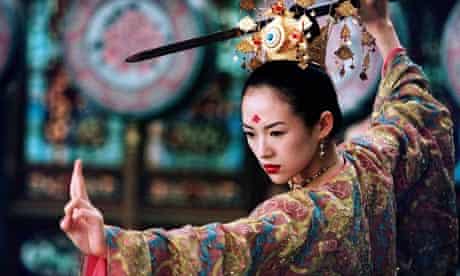
Watch the opening 20 minutes of House of Flight Daggers and it'south not hard to see why the Chinese picked its manager, Zhang Yimou, to direct the opening anniversary of the Beijing Olympics. Even though the activity unfolds within a reasonably sized brothel waiting room instead of a stadium, there'south all the elements that Zhang would multiply by the thousands in 2008: traditional Chinese music, dancing, swathes of brightly coloured silk textile, drummers and, of course, martial arts. It makes for a magnificent spectacle that'south sets a high bar for the rest of the pic. Fortunately, there's more dazzle to come up in this follow-up to Zhang's showtime wuxia film, Hero. Zhang's 2006 Curse of the Golden Flower ended the trilogy, but for many the romantic, operatic yet satisfyingly compact Flying Daggers represents the all-time of the iii.
Set during the Tang dynasty, two law captains, Leo (Andy Lau, all-time known for the thematically-not-dissimilar Infernal Affairs trilogy) and Jin (hunky Takeshi Kaneshiro) are searching for the leader of the Flying Daggers, a animus group. They suspect blind courtesan Mei (Zhang Ziyi) may be a secret member of the Daggers, so Jin, posing every bit a citizen, busts her out of jail and goes on the run with her, pursued by Leo and numerous expendable officers. Dear seems to flower between Jin and Mei, but no one and naught are as they seem hither.
Although the fights are terrifically choreographed past Tony Ching Siu-tung – especially a bamboo-forest chase that tops Crouching Tiger, Hidden Dragon and a terminal mano-a-mano in the snow – judged against other classic martial arts films, Daggers is actually a fiddling light on combat scenes. Indeed, the fighting is and then stringently stylized information technology's more like dancing with knives. No affair: the love story may exist nigh as schematic every bit the motion-picture show's rigorous use of colour, yet the interim is then powerful from the core trio that deep emotional depth is created seemingly out of nothing. Leslie Felperin
3. Police Story
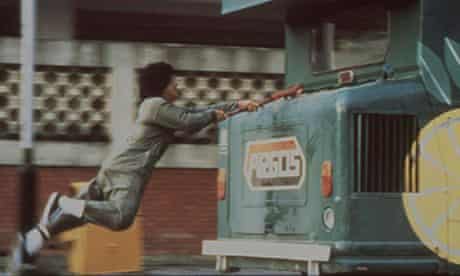
Although information technology was obvious at the time, it seems foreign now that Jackie Chan was originally groomed by at to the lowest degree ane Hong Kong producer as a successor to Bruce Lee, the lithe master of martial arts whose style was near laughably serious in its grim-faced intensity. After a few tryouts in the genre, however, Chan took things in a much more comedic, simply no less athletic road, which is why, after breaking out in the Yuen Woo-ping classic Drunken Master, the quondam stuntman found himself in Hollywood, adding light relief to The Cannonball Run in 1981.
Chan's Hollywood career, however, didn't pan out, and later a disappointment in 1985 with The Protector – a collaboration with neo-grindhouse managing director James Glickenhaus, maybe non the nearly sympatico of all possible talents – Chan returned to Hong Kong to take matters into his own hands, directing and cowriting Police Story, in which he played a disgraced cop who is forced to go hugger-mugger and articulate his name subsequently being framed by drug barons.
Making a direct rebuttal of the Hollywood way of doing things (in his mind, sloppily and half-heartedly), Chan prioritised the fights and stuntwork, using the genre elements mostly as filler. Refusing to use a torso double for every scene (bar one that involved a motorcycle), Chan began to earn his reputation as a fearless and pioneering action star. On this picture lonely, he was hospitalised with concussion, suffered severe burns, dislocated his pelvis and was most paralysed past a shattered vertebrae. The resulting moving picture was a huge hit and spawned 5 potent sequels. Seen now, it seems remarkably direct given what was to follow – the cartoonish Blitz Hour serial – although Chan certainly must have enjoyed the irony of being embraced by Hollywood for a motion picture that is, essentially, a critique of everything it was doing wrong. DW
2. Crouching Tiger, Subconscious Dragon
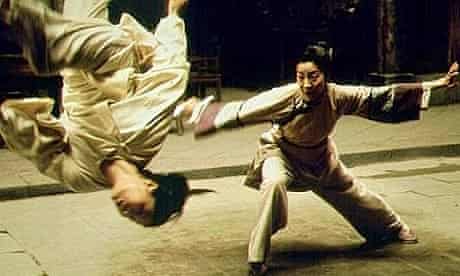
Why is Ang Lee's moving picture Crouching Tiger, Hidden Dragon such a sublime experience? Perhaps considering every bone in your body tells you lot it shouldn't work. Information technology's a tranquil action movie. Whoever heard of i of those? And it'south a dear story with a kick: a kung-fu kick. Information technology begins with the theft of a fabled sword, the Light-green Destiny. As the sword is stolen, the camera takes flight forth with the thief, for whom gravity is a restricting garment to be cast off at a moment'due south notice. The warrior Yu Shu Lien (Michelle Yeoh) gives chase, skipping blithely across rooftops that glow silver in the moonlight. When the pursuit gives fashion to combat, the rule volume of action cinema is not merely discarded simply sliced to ribbons. For viewers as well young to retrieve, the shock of seeing a Sam Peckinpah shoot-out back when slow motion was an innovation rather than a nasty virus, then the sight of these warriors levitating calmly to nosebleed-inducing heights will provide something of that same liberating jolt.
The midair skirmishes of martial arts movies were brought to mainstream audiences past The Matrix, and Lee enlisted that flick's choreographer, Yuen Woo-ping (who afterward worked on Kill Bill and Kung Fu Hustle), to take that style even further. The resulting fight routines evoke Olympic gymnastics, break dancing and those drawing punch-ups where one of the Tasmanian Devil's limbs would emerge briefly from within a frantic cyclone. And if Yu occasionally steps on her opponent's foot, she'southward not fighting dirty – it's just the simply way of ensuring that the battle remains at ground level.
For all the finesse of the choreography, the action sequences would be superficial without the emotional weight Lee brings to the moving picture, notably in the largely unspoken tenderness between Yu and her fellow warrior Li Mu Bai (Chow Yun Fat). As a director he doesn't differentiate between the manner he shoots tenderness and violence. In his hands, a love scene tin can come to be brutal, with a man's blood forming a fork beyond his lover's chest as they embrace, while a struggle betwixt opponents in the forest treetops, with the supple branches doubling as nests, catapults, rungs and bungee ropes, achieves a sensuous tranquility. RG
1. Enter the Dragon
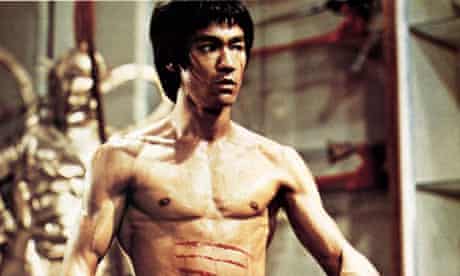
Bruce Lee purists may or may not concur that Enter the Dragon is his greatest film. But this is the one that has passed into legend: it was the jumbo box office smash of 1973 and the most famous movie of that unrivalled martial arts superstar who had died the summer before its release of a cerebral reaction to painkillers. He shared with James Dean the grim distinction of appearing posthumously in his nearly famous pic. After a career equally a child star in Hong Kong cinema – almost the Macaulay Culkin of his day – and a spell on TV'due south The Light-green Hornet, Lee exploded into activity pictures that were simply so popular and profitable that Warner Brothers agreed to make Enter the Dragon, with Lee as star and coproducer: Hollywood's first martial arts film. Robert Clouse directed, and the script was by Michael Allin, who wrote the Isaac Hayes moving-picture show Truck Turner. Lalo Schifrin composed the music.
Bruce Lee was possessed of extraordinary physical grace, balletic poise, lethal speed and explosive power. He was a master of kung fu, judo and karate, and is considered the spiritual godfather to today's mixed martial arts scene. He was not a big man, and and so his presence was better captured by the camera lens. Moreover, he had a delicately handsome, almost boyish face and had a charm and verbal fluency equally he expounded his Zen theories of combat in interviews, something more similar dynamic motivational philosophy than any fortune-cookie cliché. Lee had a presence and charisma comparable to Muhammad Ali, and that was perhaps never ameliorate captured than in Enter the Dragon. Perhaps only Jackie Chan at present rivals him as an Asian star in Hollywood – and Hollywood has not shown much involvement in promoting an Asian-American A-lister since Enter the Dragon.
Lee plays a Shaolin master who is recuited by British intelligence to enter a martial arts tournament undercover. This outcome is beingness run by a sinister megalomaniac chosen Han who is suspected of involvement in drugs and prostitution. Lee has a personal beef with Han, whose goons terrorised and attempted to rape Lee'due south kid sister – she committed suicide rather than submit. He shows up at the island with a couple of American fighters: Williams, played by Jim Kelly, provides some Shaft-mode street cred while Roper, played by John Saxon, is a playboy blazon who is close to the James Bond template. In truth, of grade, it is Lee himself who is the James Bond, but he is no womaniser. Bruce Lee has a monkish purity and spirituality, with a light amplification by stimulated emission of radiation-like focus on exposing Han – and of grade kicking donkey.
The look of the movie is exotic and improvident, particularly its inspired hall-of-mirrors showdown, with Lee sporting the weird, virtually tribal slashes across his midriff. His foreign, animal quavering cry and piercing gaze are entirely unique. But what makes Enter the Dragon outshine the residuum is the serene, almost innocent idealism of Lee himself. In the opening scenes, Lee speaks humbly to the aged Abbot at his temple, coolly takes tea with the British intelligence chief Braithwaite, and interrupts their conversation to instruct a teenage male child in martial arts. When this immature hothead is easily bested in gainsay, Lee says to him with inimitable seriousness: "We demand emotional content – not anger." Information technology is the philosophy of this martial arts archetype, and its unique star. Peter Bradshaw
More Guardian and Observer critics' top 10s
Source: https://www.theguardian.com/film/filmblog/2013/dec/06/top-10-martial-arts-movies
0 Response to "Japanese Guy Who Is Blind but Can Fight Martial Arts 1950"
Post a Comment